KICKOFF COUNTDOWN: AHSAA director Harmon goes on the offensive in public-private school battle
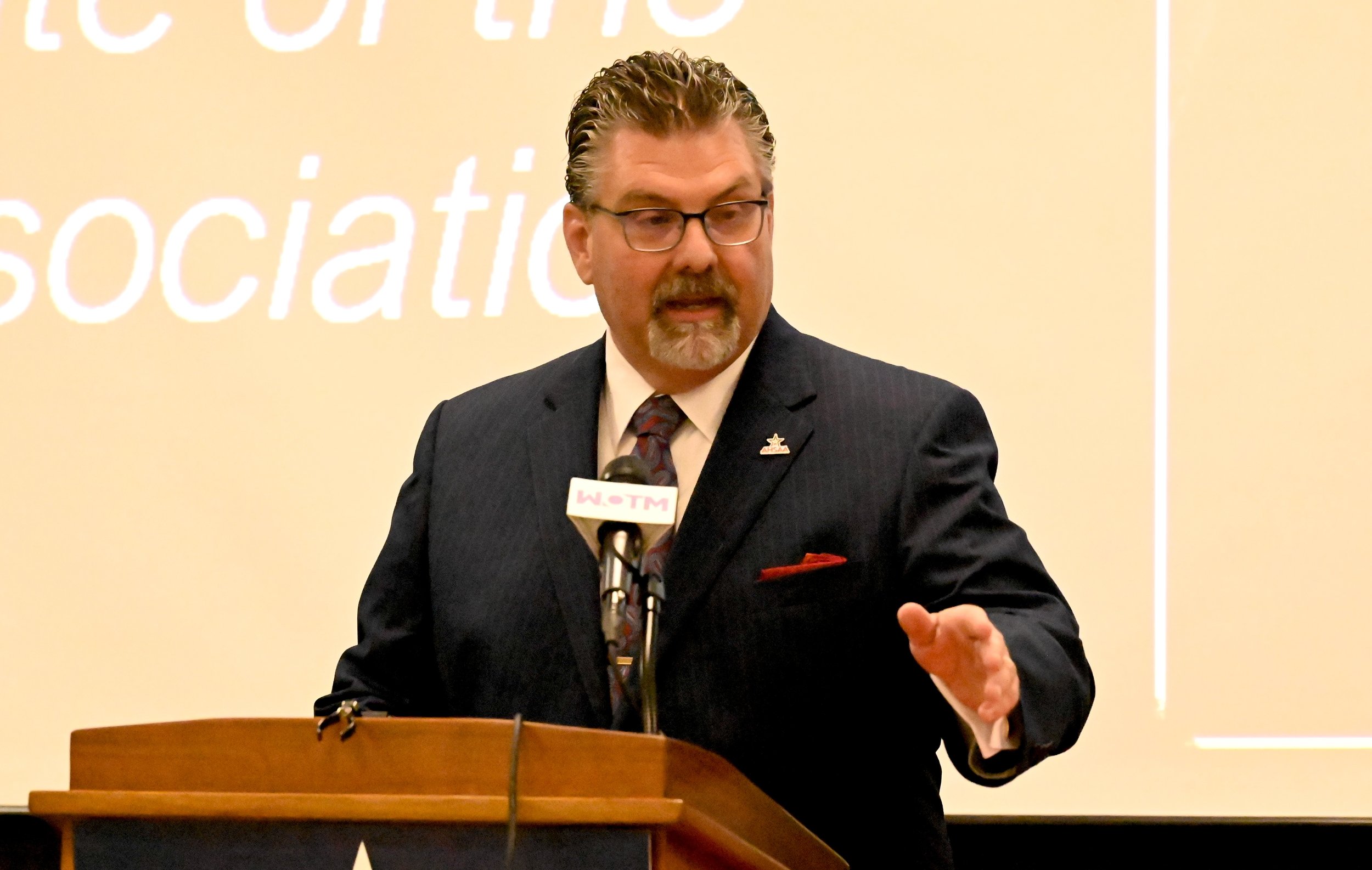
AHSAA executive director Heath Harmon gave his annual “state of the association” speech during Thursday’s Kickoff Media Day at. the league’s offices He followed later in the day with an exclusive interview with River Region Sports. (Tim Gayle)
By TIM GAYLE
Heath Harmon’s speech on Thursday carried a trace of reconciliation.
The Alabama High School Athletic Association executive director offered his thoughts on the organization during the annual media day on Thursday that signaled the approach of another football season and a press conference on the annual Kickoff Classic.
He knew he couldn’t dodge the questions concerning the rift between public schools and private schools and knew he didn’t know enough about the newly launched Gulf States Independent Athletic Association to address the private school athletic association. So his logical next step was to take the offensive with the AHSAA’s 105-year history and use its tradition as an asset. Later, in an exclusive interview with River Region Sports on WTLS radio, he reiterated his thoughts on the subject.
“From my standpoint, I can talk about what the AHSAA offers,” Harmon said. “It offers phenomenal benefits to membership. There can be disagreements, there can be things that people want to do a different way, but we have a (legislative) process to handle that. That’s why I talked about the things I did in my presentation. I just feel the need to make sure that I’m doing a good job of educating everyone on what the association does. It’s so comprehensive. There are so many benefits to membership.
“At the end of the day, the AHSAA has been around over 100 years. This idea of ‘I’m not getting what I want and I’m going to leave’ is not in the DNA of an association that has been around for over 100 years.”
One area Harmon didn’t address was the makeup of the voting process, something association officials feel is democratic in its legislative process involving the Central Board, but something private school officials feel is a structure clearly controlled by public schools, which make up more than 85 percent of the members of the association.
“You’ve really got to go back and study the evolution of how our state has handled public and private schools,” Harmon said, “and it’s been done with outstanding leadership. If you go back (to 1999) with (former executive director) Dan Washburn, where it was probably at a point where you couldn’t hold the public and private together any more, they came up with the multiplier. I’m sure private schools had a lot of issues with that, but at the end of the day it kept everybody together.
“About 10 years later, Steve Savarese was the executive director and that Central Board goes through the same thing. I can go back and look at the meetings they had, the PowerPoint that he prepared, the data he had to basically decide how they could make it work. They came up with Competitive Balance.
“Fast forward 10 years and I’m the executive director and you’re back at that fever pitch, are we going to hold it together? The big difference here was you had that coupled with the private schools who were also upset at what they had had to do those last two times. ‘What are you telling us we have to do now?”’
Harmon hoped to appease the private schools by repealing the 1.35 multiplier and Competitive Balance Factor but it still doesn’t ease the sting of being placed in separate divisions where the winning private schools are often ignored by the public schools when it comes to scheduling and the region travel for private schools is a financial burden they clearly can’t sustain.
“One of the biggest pain points that is going to come from private schools are those schools that are in a situation where the travel is really bad,” Harmon said. “In your area sports, you can have smaller areas and travel is not as bad. We discussed that, looking at private schools and putting them in areas in football. But there was a concern that it would be hard for them to find a schedule.
“It may be one of those deals where some of the smaller schools are fine, private and public. Maybe some of the larger schools feel they can’t find adequate competition if you don’t have public and private playing together. I think what I would like everybody to understand is the Central Board is in charge of classification. They depend on an executive director to be the expert on all things needed to make that decision. And the executive director depends on his staff. So we’ll work on that. We’ll get to the point where the Central Board will give me some directives on, ‘Hey, we want to have these different scenarios to see how they play out.’ And I think our Central Board will make a great decision moving forward. And it’ll be based on feedback from schools.”
Harmon added that the goal of the classification process, held every two years, is to “make it a great experience for all member schools. And that’s part of every classification, but it’s a bigger part of this one because this one was so much more historic and a different product that came out of it.”
If the administrators and athletic directors of the private schools are upset, he added, they can bring their complaints to him.
“Any private school that wants to reach out to us, they can reach out to me,” Harmon said. “But that is Buster Daniel’s specific role in addition to other duties. In addition to other duties, he will be our liaison to our private schools because with this being so new to our private schools, we want to make sure they have a voice and a means by which to communicate things that are pain points for them, moving forward.”