
QB CLUB: Former Auburn AD Jacobs kicks off meetings at Huntingdon
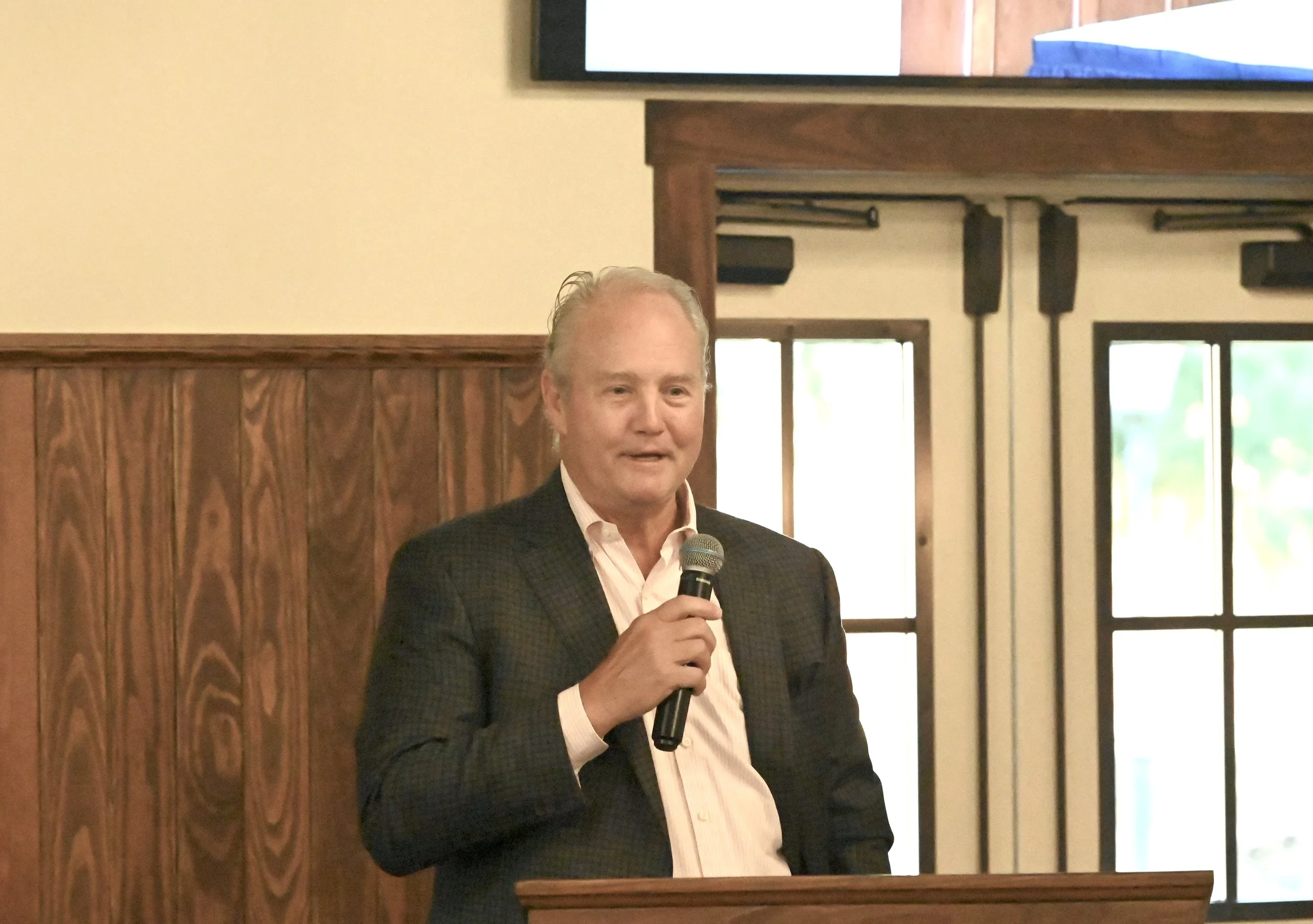
Former Auburn athletic director Jay Jacobs discusses the changes in college athletics while speaking to the River Region Quarterback Club at Huntingdon College on Tuesday. (Tim Gayle)
By TIM GAYLE
Former Auburn athletic director Jay Jacobs kicked off the 2026 season for the River Region Quarterback Club on Tuesday morning, entertaining the group for an hour at The Hut at Huntingdon College.
Jacobs was a former walk-on for the Tigers in the mid-1980s and later served as an athletic director that hired Gene Chizik in football and Bruce Pearl in basketball, but the conversation quickly shifted to the current state of college football in the country.
“Things are different now,” Jacobs said. “We had this thing at Auburn, like all SEC schools, a lettermen’s club for former players to come back and socialize. I don’t know what these guys are going to come back to these days. Michigan’s basketball team won the national championship this past year with five guys who had never played together before that year. It is just so different.
“Five years ago, what we used to worry about was recruiting classes and amateurism. (Now there’s) regional conferences -- we’ve got conferences from coast to coast -- a four-team playoff, now we’ve got 12 and just what is college football’s identity?”
Jacobs spent a few moments discussing LSU’s selection of former professional players in the transfer portal and the proposed Protect College Sports Act “that hopefully will be passed by the Senate in the middle of this month to try and slow down some of this.” While the proposed legislation will limit players to one transfer and allow payments only to returning players, Jacobs noted there were currently “no guardrails” in college sports, causing the product to lose some of its identity.
“We had 120-125 guys on a team,” Jacobs said. “Auburn is a land-grant institution. It’s where people go to school that maybe couldn’t otherwise and gives them opportunities. If it wasn’t for my opportunity as a walk-on, I wouldn’t be standing in front of you today. Now, we’ve gone from 85 scholarships to a 105-man roster.
“So at every institution, there’s 15-20 guys that used to be on a team that aren’t on a team any more. Just understand my perspective on this. I know college athletics isn’t the only way you can be successful, but it certainly does a lot to build teamwork and character, you learn time management, you learn critical thinking, you learn how to work with other people. And a bunch of guys won’t have a chance to do that because of what we’ve decided to do.”
Jacobs also expressed some reluctance on the idea of handing out millions of dollars to teenagers.
“We’re giving 18, 19, 20, 21-year-olds thousands of dollars and they’re going to leave college at some point and they’re going to go and work and maybe make minimum wage,” Jacobs said. “What are we doing? All the schools … try to educate these guys on how to handle their money. When you grow up and you are the provider to your family and everybody’s looking for a car and a house, it’s hard to manage your money. That’s why 73 percent of NFL players go broke. And now we’re doing it for 18-year-olds. I think we’re setting it up for disaster.”
After leaving Auburn, Jacobs worked for five years at the University of Florida, but quickly pointed out the difference between college athletics in the state of Alabama and college athletics in Florida.
“When you’re down there and there’s 20 million people, there are three or four professional teams and three or four college teams, it’s not quite like it is here with the two of us,” Jacobs said. “Sometimes, we can really enjoy this, sometimes we take it too seriously.”
The Quarterback Club also paid tribute to member Marlin “Scooter” Dyess, the former University of Alabama tailback who passed away on Friday at the age of 88.
The Quarterback Club will return on Sept. 16 with Jeris McIntyre, Auburn director of football and alumni relations, and Harding Harper, director of recruiting at Auburn.